Little known but inspirational stories from Black history

Category: World War II

Hugh Mulzac: First Black Captain of a WWII Liberty Ship

Captain Hugh Mulzac
Captain Hugh Mulzac
Source: Wikimedia Commons (public domain)

Hugh Mulzac: A Highly Qualified Shipmaster

Hugh Nathaniel Mulzac (1886-1971) was a master seaman, well qualified to command a merchant vessel. He had many years of sea duty aboard British, Norwegian, and American merchantmen. After studying at the Swansea Nautical College in South Wales, he earned a mate’s license in 1910, qualifying him to be second in command.

With those credentials he was able to serve as a deck officer on four ships during World War I. Then, in 1920 he passed the U. S. shipmaster exam with a perfect score of 100 and earned a master’s rating. He was now fully qualified to serve as the captain of a vessel in the United States Merchant Marine.

But there was one apparently insurmountable problem: Hugh Mulzac was black.

A Captain Who Could Only Find Work As a Cook

Qualified as he was to command an entire ship, the only jobs Hugh Mulzac could get at sea were in the galley. For two decades, he was the most over-qualified ship’s cook in maritime history. (He made the most of that limitation by becoming an acknowledged expert in shipboard food service management).

German U-Boats Take a Toll

But then came World War II. When America entered the war in December of 1941, Germany immediately began stationing submarines off the East Coast of the United States to sink supply ships headed for Europe. The U-boats were very successful. In 1942 an average of 33 Allied ships per week were sunk.

U-Boat captain and crew, 1941
U-Boat captain and crew, 1941Source: Buchheim, Lothar-Günther via Wikimedia (CC-BY-SA 3.0)

Serving as an auxiliary to the US Navy in time of war, the Merchant Marine suffered the greatest percentage loss of any branch of the American military.

Those losses were tragic for the seamen who died and their families. And the loss of such a large number of cargo vessels, putting in jeopardy the ability of “the arsenal of democracy” to get troops and war materiel to the European theater, was potentially devastating to the Allied war effort.

SS Pennsylvania Sun, torpedoed by a German submarine, July 1942
Source: U.S. Navy via Wikimedia (public domain)

But, ironically, it was those heavy losses in both ships and men that finally gave Hugh Mulzac his opportunity to become the ship’s captain he was so well qualified to be.

Liberty Ships to the Rescue!

It was clear that if the U. S. and its Allies were to receive the supplies needed to carry on the war, thousands of new cargo vessels would have to be put afloat.

That need was filled through the famous “Liberty Ship” program. These vessels, all built to the same standardized plan, were designed to be mass produced as quickly as possible. By war’s end, 2,711 of them would be launched.

VIDEO: Building Liberty Ships in Georgia

A Shortage of Seamen Forces a Change in Racial Attitudes

But it was not only ships that had to be provided in massive numbers. Each ship had to be manned by a crew of trained seamen. And with the pool of qualified merchant sailors being rapidly diminished by losses to the U-boats, the Merchant Marine was finally pushed to the point of employing experienced seamen wherever they could be found. Even if they happened to be black.

So, it came about that in 1942, Hugh Mulzac, with qualifications far exceeding those of anyone still on shore by that point, was finally offered command of a ship.

But there was still a problem so significant that Mulzac initially refused the offer. The U.S. Maritime Commission wanted him to captain a vessel with a segregated, all-black crew. And Hugh Mulzac would have none of it.

A Seaman Becomes an Activist for Racial Equality

Born on March 26, 1886 in the British West Indies, Hugh Mulzac had first come to the United States as a crewman aboard a Norwegian vessel that landed in North Carolina. It was then, as he says in his autobiography A Star to Steer By, that he was first confronted with the “barbarous customs of our northern neighbors.”

Although he immigrated to the United States in 1911, becoming a citizen in 1918, Mulzac never got over his abhorrence of the “barbarous customs” of race prejudice and segregation that afflicted his new homeland, and absolutely refused to willingly participate in perpetuating that evil system. He would stick by that determination even when it seemed doing so would prevent him from ever fulfilling his dream.

In 1920 Mulzac served as mate on the SS Yarmouth, a ship of African American activist Marcus Garvey’s Black Star Line. Although he briefly became the captain of the Yarmouth, he grew disillusioned with the way Garvey’s shipping company was managed (it went out of business in 1922). Mulzac resigned in 1921 to start his own maritime school. That only lasted a year, and Mulzac soon found himself once again at sea, relegated to the galleys of the ships he served on.

With his first-hand experience of the pernicious effects of racial prejudice in the shipping industry, Mulzac in 1937 became a founding member of the National Maritime Union. There was one key issue that led Mulzac to involve himself in the labor movement.

“Most important for me,” he said, “was the inclusion of a clause in the constitution providing that there should be no discrimination against any union member because of his race, color, political creed, religion, or national origin. This was a milestone in the history of the waterfront…it was the first maritime union to establish this basic principle and to enforce it.”

Mulzac Refuses To Command a Segregated Ship

With this commitment to racial equality on the seas, Hugh Mulzac was in no humor to compromise about shipboard segregation. When, in 1942 at the age of 56, he was offered what would likely be his last opportunity to command a vessel, but with the proviso that there must be no race mixing among the crew, Mulzac resolutely stuck by his refusal to captain a segregated ship. “Under no circumstances will I command a Jim Crow vessel,” he told the Maritime Commission, and turned down the offer.

Under no circumstances will I command a Jim Crow vessel
— Captain Hugh Mulzac

He later expressed his outrage in his autobiography:

“If there was ever a moment when the real meaning of democracy could and had to be demonstrated to the peoples of the world, the moment was now! And what was America’s answer in this hour of need? A Jim Crow ship! Named for a Negro, christened by a Negro, captained by a Negro, and no doubt manned by Negroes!”

Finally, desperate for qualified officers, and spurred on by protests by the NAACP and other black organizations, the Maritime Commission relented and dropped their insistence on segregation. Hugh Mulzac would finally have his ship, and an integrated crew with it.

The SS Booker T. Washington: First Liberty Ship Named for an African American

The ship Captain Mulzac would command was a pioneer for racial equity in its own right. Each Liberty Ship was named for some prominent American. Out of the total of 2,711, seventeen would be named for African Americans. The very first of these was the SS Booker T. Washington.

The SS Booker T. Washington

Keel laidAugust 19, 1942
LaunchedSeptember 29, 1942
CompletedOctober 17, 1942
Displacement14,245 tons
Length441 feet
Speed11 knots
Scrapped1969

From the moment of its naming, the Booker T. Washington was a source of pride and hope, and as importantly, jobs for the African American community. It was built by racially mixed construction crews, many of whom were gaining access, for the first time in their lives, to training for something beyond menial jobs.

The shipyard in Richmond, California where the Booker T. Washington was constructed eventually employed 6000 African American workers, 1000 of them women.

Proud workmen helping build the Booker T. Washington
Source: Alfred T Palmer at Library of Congress (public domain)
Original 1942 caption: Jesse Kermit Lucas, experienced Negro welder at the California Shipbuilding Corporation's yards, is shown instructing his white welder apprentice, Rodney Gail Chesney, as the two work on the "Booker T. Washington"
Original 1942 caption: Jesse Kermit Lucas, experienced Negro welder at the California Shipbuilding Corporation’s yards, is shown instructing his white welder apprentice, Rodney Gail Chesney, as the two work on the “Booker T. Washington”
Source: Alfred T Palmer at Library of Congress (public domain)

Massive Press Coverage of the New Ship and its Captain

At a time when the U. S. Navy would allow black sailors to serve only as stewards, the story of the Booker T. Washington and her African American skipper received wide coverage. For example, the October 5, 1942 issue of Time Magazine had the following story:

“Slight, grizzled Hugh Mulzac, ex-seaman, ex-mess boy, was catapulted front and center last week to become a Symbol of Negro participation in the war. When the Liberty freighter Booker T. Washington goes into service from California Shipbuilding’s Los Angeles yard in mid-October, the Maritime Commission decided, she will be commanded by a British West Indies-born Brooklyn man, the first Negro to hold a U. S. master’s certificate and the first to command a 10,500-ton ship.

“Captain Mulzac not only promised that he would be able to get qualified Negro officers to serve under him but said that he knew white as well as Negro crewmen willing to serve under him—for the Booker T. is not to be a Jim Crow ship. The Booker T. (for Taliaferro) will serve not only in the war of ocean transport but in the war against race discrimination.”

Captain Mulzac was as good as his word. The crew of 81 he assembled consisted of 18 different nationalities from eight nations and thirteen American states. The captain later noted in a newspaper article that among the crew were white seamen from Florida and Texas.

“They were the finest fellows I ever sailed with,” Captain Mulzac said, “and their attitudes were much different from that of the Southerners you meet in those States.”

The Booker T. Washington is Launched

The launching of the ship, on September 29, 1942, was an occasion of deep significance and celebration for the entire African American community. The event was front page news in the black press all across the nation. A headline in the Baltimore Afro-American trumpeted, “Launching Called Morale-Building Show of Democracy.”

Not only did the Afro-American do full-page spreads on the story, it went so far as to pay the way of Captain Mulzac’s daughter from Baltimore to the Wilmington, California launch site, and then featured her first-person account of her “Thrilling Transcontinental Flight.”

Marian Anderson (center), Mary McLeod Bethune (left), and other dignitaries at the launching of the Booker T. Washington
Source: Alfred T Palmer at Library of Congress (public domain)

Another luminary who had her way paid to the launching was Miss Louise Washington, granddaughter of Booker T. Washington. An employee of the US Department of Agriculture, she was sent to the event by the Maritime Commission.

Famed contralto Marian Anderson, accompanied by pioneer educator Mary McLeod Bethune and other prominent dignitaries, christened the new vessel. Ruby Berkley Goodwin later wrote a poem about the occasion:

Marian Anderson christens the Booker T. Washington
Source: Alfred T Palmer at Library of Congress (public domain)

We Launched A Ship – Ruby Berkley Goodwin

On one never-to-be-forgotten day, we launched a ship.
The full-throated voice of Marian Anderson proclaimed,
“I christen thee Booker T. Washington.”
A bottle broke and champagne sprayed the prow
Of the giant liberty ship as she slid proudly down the ways
And sat serenely on the broad face of the ocean.

. . .

We launched a ship –
A ship with a glorious mission,
And it became the symbol of a
Dawning brotherhood throughout the world.

The one who was perhaps most deeply affected by the launching of the Booker T. Washington was Captain Hugh Mulzac himself. He later wrote:

“Everything I ever was, stood for, fought for, dreamed of, came into focus that day. The concrete evidence of the achievement gives one’s strivings legitimacy, proves that the ambitions were valid, the struggle worthwhile. Being prevented for those twenty-four years from doing the work for which I was trained had robbed life of its most essential meaning. Now at last I could use my training and capabilities fully. It was like being born anew.”

Captain Mulzac and his officers after arriving in England on the Booker T. Washington's maiden voyage
Captain Mulzac and his officers after arriving in England on the Booker T. Washington’s maiden voyage. Source: U.S. National Archives via Wikimedia (public domain)

World-Wide Impact of the Booker T. Washington

The impact of the Booker T. Washington entering into the maritime service with the first ever black captain in United States Merchant Marine history was felt all around the world. For example, one event that Captain Mulzac considered a highlight of the ship’s maiden voyage happened when they reached Panama. The Baltimore Afro-American tells the story in its January 9, 1943 issue:

“When they first dropped anchor in (the) Panama Canal Zone, all of the colored schools closed to celebrate the arrival of the Booker T. Washington and the first colored skipper to be in complete charge of a United States ship.”

"Democracy In Action" by Charles Henry Alston
“Democracy In Action” by Charles Henry Alston
Source: U.S. National Archives via Wikimedia (public domain)

An Exemplary Record of War-Time Service

Starting with its first trans-Atlantic crossing early in 1943, the Booker T. Washington and her captain built an outstanding record. They made 22 successful round trips from the US to the European, Mediterranean, and Pacific theaters of war, ferrying 18,000 troops and thousands of tons of supplies, including ammunition, airplanes, tanks, locomotives, jeeps, and more.

Each Liberty Ship was armed with deck guns and antiaircraft guns manned by crews provided by the Navy. The Booker T. Washington was in action against the enemy several times, and is credited with shooting down two enemy airplanes. But not one of her own crew was lost.

Captain Mulzac himself was highly esteemed by his crew. The Baltimore Afro-American of January 16, 1943 records one crewman’s reaction after the Booker T. Washington’s first voyage. Harry Alexander, described as a white deck engineer, said:

“I’ve been on ships where the captains set up nights thinking of things to do to irritate the crew. Our old man spends his time teaching navigation.”

That was not, by any means, an isolated expression of regard. A January 16, 1964 article in the Village Voice reporting on an exhibition of Captain Mulzac’s paintings, records some memories from another of the skipper’s former crew members. Irwin Rosenhouse, whose gallery was hosting the event, recalled the impact his old commanding officer had made on him:

“The Booker T. was the only ship I’ve ever been on which had a sense of purpose from the top down,” Rosenhouse told The Voice. He recalled the classes in seamanship, in art, and in international affairs, as well as the tongue-lashing he’d received when he chose to stand watch on a stormy night inside.”

Captain Mulzac and the Booker T. Washington became an inspiration to young people of color, a signal that they, too, could dream and through hard work, see those dreams fulfilled. Joseph B. Williams, for example, served under Captain Mulzac as a cadet-in-training. He would go on to become the first African-American to graduate from the U.S. Merchant Marine Academy. For him the captain was a “demanding taskmaster” who taught him “how to be a qualified officer.”

Another young man influenced by the example of the Washington and her captain was 16-year old Merle Milton of Connersville, Indiana. He told MAST Magazine in 1944:

“Right now I’m shipping out as an ordinary seaman, but I don’t expect to stay that way for long. I want to go to officers’ school and the proposed Seamen’s Bill of Rights provides for that. Who knows, maybe I’ll get a master’s license some day like Captain Hugh Mulzac on the SS Booker T. Washington.”

The Aftermath of the War

Despite the acclaim garnered by Captain Mulzac for his performance on the bridge of the Booker T. Washington, once the war was over, race prejudice came roaring back.

In 1947 the Booker T. was turned back over to the Maritime Commission. Captain Mulzac went into the hospital for a leg operation. When he emerged, he found himself, as he put it, “on the beach” again. There were no maritime jobs for him or any of the other black officers who had served with such distinction during the war. Hugh Mulzac would never again command a ship.

It got worse. During the McCarthy era, Mulzac’s labor activism was used against him by Red-baiters. In 1950 he ran for President of the borough of Queens in New York City, getting a respectable 15,500 votes. But he had run on the ticket of the American Labor Party, which some politicians accused of being influenced by Communists. All this resulted in Mulzac being branded a security risk, and his master’s license was suspended. He fought that edict in court, and in 1960 a federal judge restored his license. That allowed him, at age 74, to once again go to sea, serving not as a captain, but as a night mate.

But Captain Mulzac never allowed the bigotry that confronted him to control his life. He had started painting during the last voyage of the Booker T. Washington. Now he became more serious about it. His work was exhibited in a number of galleries in New York City to very positive reviews.

Captain Mulzac Opens Art Show
Captain Mulzac Opens Art Show. Source: Village Voice, January 16, 1964

Legacy

Hugh Mulzac was certainly a pioneer for racial justice. He, along with the multi-racial crew of the Booker T. Washington, demonstrated what people of color could accomplish when given the chance, and that people of all races can live and work together in harmony.

“They said it wouldn’t work, but it did,” he said.

But beyond that tremendous accomplishment against great odds, Hugh Mulzac knew that his life and career were dedicated to an even bigger idea. He said,

“I had to begin to understand that discrimination was not only my problem, but a fight of the whole colored race – and of whites too, for that matter, though precious few seemed to realize it.”

For his willingness to put his career on the line to defend the principle that prejudice and discrimination have no place in a democratic society, we all owe Hugh Mulzac a well deserved vote of thanks.

Captain Hugh Mulzac died in East Meadow, NY on January 30, 1971 at the age of 84.

Further Reading:

© 2013 Ronald E. Franklin
The Freeman Field Mutiny: How Tuskegee Airmen Challenged Segregation in World War II

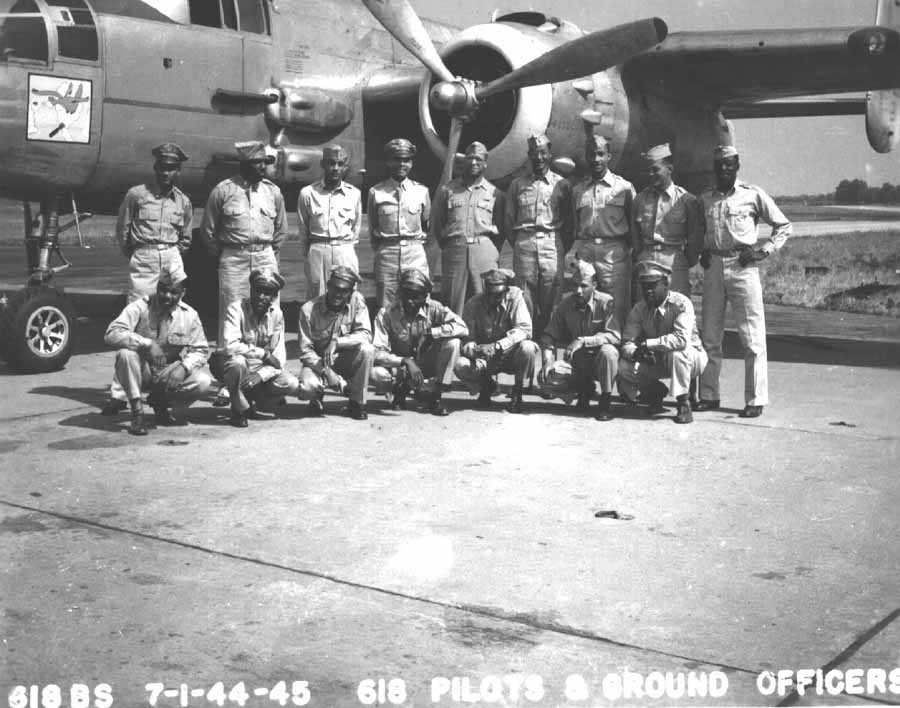
Pilots and ground officers of the 477th with one of their B-25 bombers
Source: United States Army Air Forces (public domain)

What Was the Freeman Field Mutiny?

In April 1945, 101 African American officers of the U.S. Army Air Force’s 477th Bombardment Group were arrested at Freeman Field in Indiana and charged with violations under the 64th Article of War. The maximum penalty for their alleged crimes during time of war was death.

The Unit the Army Didn’t Want But Couldn’t Avoid

The Army never wanted the 477th Bombardment Group in the first place. In fact, the commander of the Army Air Forces (AAF), General Henry (Hap) Arnold, did his best to kill the unit before it got started. But the political pressure was just too great.

That was because the 477th would be the first bomber unit in the United States military to be staffed by African American crews. It was born out of President Franklin D. Roosevelt’s need to shore up his support among Black voters in the 1940 elections.

After persistent and growing public pressure from the Black press, organizations like the NAACP, and from Roosevelt’s own wife, Eleanor, the president and Congress authorized the inclusion of African Americans in military aviation training programs.

That led to the establishment of a flying school at Tuskegee University in Alabama. Graduates of the training program there, the famous Tuskegee Airmen, went on to compile a stellar record flying fighter planes during World War II.

But even while the Tuskegee Airmen fighter pilots, like those of the 332nd Fighter Group (the famed Red Tails), were winning Distinguished Unit Citations in the skies over Europe, no African Americans had been accepted to fly bombers. The 477th was created to correct that omission.

Members of Tuskegee Class 43-B
Source: U.S. Air Force Historical Research Agency (public domain)

Pilots trained at Tuskegee, some of them by that time seasoned combat veterans as fighter pilots, volunteered to form the nucleus of the 477th Bomber Group. Just as they had proven that African Americans could perform at a high level flying P-47 and P-51 fighters against the best the Luftwaffe could throw at them, they were determined to demonstrate they were just as capable in flying the B-25 Mitchell bomber.

But beyond proving once again the capabilities of African Americans as flyers, these men were also determined to receive the respect due them as officers of the United States Army. And that determination led to some serious clashes with the AAF’s command structure.

The 477th Is Born Under a Segregation Cloud

After an initial false start, the 477th bomber group was reactivated on January 15, 1944, and stationed at Selfridge Field, about 40 miles from Detroit. Problems began almost immediately.

The commander of the 477th was Colonel Robert R. Selway, Jr., a confirmed segregationist. So was Selway’s superior, Major General Frank O’Driscoll Hunter, commander of the First Air Force.

Hunter was determined to maintain strict racial segregation in the units under his command. But he had a problem. In 1940 the Army had issued regulation AR 210-10, which said in part:

No officers club, mess, or other similar social organization of officers will be permitted by the post commander to occupy any part of any public building, other than the private quarters of an officer, unless such club, mess, or other organization extends to all officers on duty at the post the right to full membership, either permanent or temporary, in such club, mess, or organization, including the right equally with any and all other members thereof to participate in the management thereof, in which the officers concerned have an interest.

Under that regulation it was clearly illegal to deny African American officers membership in and use of any officers club on a base where they were stationed. But General Hunter believed he could circumvent the requirements of AR 210-10 and continue his segregationist policies.

Major General Frank O. Hunter
Major General Frank O. Hunter.
Source: USAAF via Wikipedia (public domain)

Gen. Hunter’s Policy of Segregation Receives a Rebuke

Even before the 477th arrived at Selfridge Field, General Hunter moved to ensure that segregation would be maintained.

There was only one officers club on the base, and Hunter instructed the base commander, Col. William L. Boyd, that the club was to be reserved for Whites only. Hunter promised to have a separate club built for Black officers, but until that happened, they would have to be content with not having access to any officers club.

They were not content.

On January 1, 1944, three Black officers of the 332nd Fighter Group, already stationed at Selfridge before the 477th was activated, entered the officers club and asked to be served. Col. Boyd confronted them and, using racially insulting language, informed them that they were not welcome there. He officially ordered them to leave.

The officers did so. But a later investigation by the War Department determined that Col. Boyd’s actions were in clear violation of AR 210-10. He was officially reprimanded and relieved of his command. The language used in the reprimand was unequivocal:

  1. Investigation by the Office of the Inspector General has disclosed that racial discrimination against colored officers. . . was due to your conduct in denying to colored officers the right to use the Officers Club. . . . Such action is in violation of Army Regulations and explicit War Department instructions on this subject.
  2. As a commissioned officer of the Regular Army of many years standing you must have had knowledge that your conduct in this respect was highly improper. Not only does your conduct indicate a lack of good judgment, but it also tends to bring criticism upon the military service.
  3. You are hereby formally reprimanded and admonished that any future action on your part will result in your being subjected to the severe penalties prescribed by the Articles of War.

General Hunter was dismayed by his subordinate being reprimanded for obeying his orders. But he was not deterred from pursuing his segregation agenda. One reason for his persistence was that despite the official action taken against Col. Boyd, Hunter was being told informally that his superiors, all the way up to General Hap Arnold, approved of his policy. (Significantly, however, the chain of command refused Hunter’s request that they put that approval in writing).

General Hunter Publicly States His Commitment to Segregation

When the first contingent of the 477th’s officers arrived at Selfridge Field to begin training, General Hunter held a briefing to let them know exactly where he stood. He told them:

The War Department is not ready to recognize blacks on the level of social equal to white men. This is not the time for blacks to fight for equal rights or personal advantages. They should prove themselves in combat first. There will be no race problem here, for I will not tolerate any mixing of the races. Anyone who protests will be classed as an agitator, sought out, and dealt with accordingly. This is my base and, as long as I am in command, there will be no social mixing of the white and colored officers. The single Officers Club on base will be used solely by white officers. You colored officers will have to wait until an Officers Club is built for your use. Are there any questions? If there are, I will deal with them personally.

But the officers of the 477th were not intimidated by their commanding general’s unbending stance. Instead, they began developing a plan.

Negroes can’t expect to obtain equality in 200 years, and probably won’t except in some distant future. . . I will not tolerate any mixing of the races and anyone who protests will be classed as an agitator, sought out, and dealt with accordingly.

General Frank Hunter

The 477th Is Moved From Base to Base for Racial Reasons

In June of 1943 the city of Detroit had been the scene of severe race riots which many in the Army command structure, including General Hunter, believed had been fomented by “agitators.” Sensing the unhappiness of Black officers at being subjected to discrimination at Selfridge Field because of their race, General Hunter became concerned that the proximity of the base to Detroit might allow the racial unrest to spread to the 477th.

That led, on May 5, 1944, to the 477th being moved, suddenly and without warning, from Selfridge to Godman Field near Fort Knox, Kentucky. Segregation was easier to maintain at Godman because of its proximity to Fort Knox.

The Black officers assigned to Godman were allowed use of the only officers club on the base. But White officers were officially assigned to Fort Knox, not Godman, and were able to join the exclusively White officers club there.

Godman, however, proved totally unsuited for the training of a bomber group. It had a number of inadequacies, including runways too short to allow B-25s to land. So, starting on March 1, 1945 the 477th was moved once more, this time to Freeman Field in Indiana. The transfer was spread over several weeks, and was scheduled to be completed in early April.

A great advantage of Freeman Field, from the point of view of General Hunter and Colonel Selway, was that it already had two club facilities, one for officers and another for non-commissioned officers. Col. Selway simply dispossessed the non-coms from their club, and designated it for use by the officers of the 477th.

However, Hunter and Selway had learned a lesson from the reprimand given Col. Boyd for his violation of AR 210-10. They needed a way to justify limiting Black officers to the second club while barring them from the first.

Col. Robert R. Selway reviewing the 618th Bomber Squadron (part of the 477th).
Source: USAAF via Wikipedia (public domain)

Uncle Tom’s Cabin

The plan they settled on was to designate the first club as being for “permanent” and the second for “temporary” officers on the base (Selway would later change those designations to “supervisors” and “trainees”). They then named all the White instructors as supervisors and all the Black officers as trainees. That would allow them to deny any charge of having a racially discriminatory purpose in mandating the separation of the two groups.

But nobody was fooled. Even Hunter and Selway themselves found it difficult to keep up the pretense – transcripts of their telephone conversations show them sometimes slipping and referring to the “white” officers club.

The officers of the 477th understood perfectly well the subterfuge being practiced by their superior officers, and determined to combat it. They dubbed the club assigned to them “Uncle Tom’s Cabin” and refused to use it.

On April 1, 1945 Col. Selway issued an order officially putting his plan of segregation by dividing “supervisors” from “trainees” into effect.

Black Officers of the 477th Defy Their Commander’s Segregation Policy

Word of Selway’s order quickly made its way back to Godman Field, where the last contingent of 477th officers was preparing for their move to Freeman Field. They immediately began strategizing about how they would combat the illegal segregation that Hunter and Selway had instituted at Freeman.

Under the leadership of Lt. Coleman A. Young, who in 1974 would become the first Black mayor of Detroit, the group developed a plan of non-violent protest.

When this last group of 477th officers arrived at Freeman Field on the afternoon of April 5, 1945, they began putting their strategy into motion that very evening.

As they had planned, the Black officers began going to the White officers club in small groups to request service. They were met by Major Andrew M. White, who was in charge of the club.

After the first group of three was turned away by Maj. White, Lt. Joseph D. Rogers, assigned as Officer of the Day (OOD) and armed with a .45 caliber automatic weapon, was stationed at the entrance. As each group approached, Lt. Rogers ordered them to leave. When they refused to do so, Maj. White placed them under arrest “in quarters.”

Upon being arrested each group of Black officers quietly left the club and returned to their quarters. That night 36 officers were arrested and confined to quarters.

Included in the last group to attempt entrance to the club on the night of the 5th was Lt. Roger C. Terry. The OOD, Lt. Rogers, would later claim that as he attempted to block the Black officers from entering the club, Lt. Terry, as well as two other officers who sought to enter the club that night, jostled him in order to get past him.

The next day additional groups totaling 25 more officers went to the club and were arrested. In all, over the two days of the protest, a total of 61 officers of the 477th were placed under arrest.

The Army Instructs Col. Selway to Release the Arrested Officers

The AAF now had a public relations mess on its hands. An investigation was launched, and the Air Inspector of the First Air Force recommended dropping the charges against most of the officers due to doubts as to whether Col. Selway’s order segregating the clubs had been properly drafted. If the wording of the order was flawed, the arrestees could not be held accountable for violating it.

Most of the officers were released. But Lt. Terry and two others, Lts. Marsden A. Thompson and Shirley R. Clinton, were held on the charge of offering violence (the jostling claimed by Lt. Rogers) to a superior officer.

VIDEO: A student documentary on the 477th

Col. Selway Tries Again to Force Compliance With His Segregation Directive

With his first attempt to enforce segregation having fallen apart, Col. Selway now determined to reissue his order in a form that would allow no escape if the Black officers violated it. On April 9 he published Regulation 85-2, detailing his requirement that “trainees” were not to use the “supervisors” officers club, and had it posted to camp bulletin boards.

To make sure no one could claim to have not seen it, the next day he called an assembly of all the Black officers and had the regulation read to them. They were then ordered to sign a statement affirming that they had read and fully understood the regulation.

The Black officers, believing that Selway’s regulation was illegal and therefore could not be understood as a lawful order, refused to sign. A group meeting was held with fourteen of the officers to try to convince them to sign. Only three of the fourteen did so.

Finally, on the advice of officials of the First Air Force, Col. Selway set up a board having two White and two Black officers. Each officer of the 477th was brought individually before this board and ordered to sign a certification of having read Selway’s regulation.

They were told that they could strike out the words “fully understand,” and even use their own wording in their certification. However, if they continued to refuse to sign after having been ordered to do so, they would be in violation of the 64th Article of War, which relates to disobeying a direct order of a superior officer in time of war. The statutory penalty when convicted of such an infraction was death.

I’d be delighted for them to commit enough actions that way so I can court-martial some of them.

General Frank Hunter

Mutiny! 101 Black Officers Refuse to Obey Their Commander’s Order

Some officers now did sign the certification, many after modifying it with their own wording, or adding a note saying that they were signing under protest. But 101 of the 425 officers of the 477th, convinced that Col. Selway’s regulation was illegal, and determined to no longer bow to the racial discrimination that was being practiced throughout the Army, still refused to sign.

The mass refusal of these officers to obey a direct order from their superior is what has become known as the “Freeman Field Mutiny.”

Back in March, in apparent anticipation that the officers of the 477th might protest against his segregation orders, General Hunter had told Colonel Selway in a telephone conversation, “I’d be delighted for them to commit enough actions that way so I can court-martial some of them.” He now had his wish, and pushed hard to have the Black officers prosecuted under the 64th article of war.

The 101 who refused to sign (they became known as the 101 Club), were placed under arrest and surreptitiously sent back to Godman Field, under guard, to await court martial.

One of the officers, Lt. Leroy Battle, remembers, “They pulled us out of our barracks at 2 or 3 o’clock in the morning. They said ‘We’re going to hang you because you disobeyed a superior officer in a time of war.’”

The 101 arrested officers about to board transports to take them to Godman Field for court martial. Photo taken with a hidden camera to avoid confiscation.
Source: Harold J. Beaulieu via Wikipedia (public domain)

The Army Once Again Steps Back From the Brink

Placing more than a hundred African American officers, some of them combat veterans, under threat of death for disobeying an order cooked up to enforce illegal segregation was not a prospect the Army’s brass looked on with the same delight General Hunter seemed to have. The Black press, national civil rights organizations, and a number of members of Congress began to emphatically weigh in.

The Army’s “Advisory Committee on Negro Troop Policy,” headed by Assistant Secretary of War John J. McCloy, began an investigation. Although the AAF Inspector General produced a report backing Col. Selway, claiming that his regulation 85-2 was consistent with War Department policy, the McCloy Committee was not impressed. The sole African American member of the committee, Truman K. Gibson, Civilian Aide to the Secretary of War, described the AAF’s report as “a fabric of deception and subterfuge.”

The committee reported to Secretary of War Henry L. Stimson that Selway’s actions were “not in accord with existing Army regulations,” and recommended that his “non-concurrence with Army regulations and war department policies be brought to the attention of the Commanding General, Army Air Forces, for appropriate action.”

Finally, on April 19, 1945, General George C. Marshall, the armed forces Chief of Staff, ordered the 101 released. He did allow General Hunter to place administrative reprimands in each of their records.

However, the three officers accused of “jostling” a superior officer during the officers club demonstration, Lts. Terry, Thompson, and Clinton, were not released. Instead, they were subjected to court martial.

But by the time the trials of the three took place, the AAF had already begun to take corrective action. Col. Selway was relieved of command of the 477th, replaced by Lt. Col. Benjamin O. Davis, Jr., a tested combat leader, and the first African American graduate of West Point in the 20th century.

(By the way, at West Point Davis had endured four years of silence. None of the other cadets would so much as speak to him outside the requirements of official duty during that entire time).

The 477th was returned to Godman Field, where the entire chain of command was replaced by Black officers under Col. Davis.

With the new command structure at Godman Field, the court that would try the three men accused of jostling a superior would consist entirely of Black officers.

Three Officers Are Court-Martialed

The accused officers did not lack for fire power on their defense team. The defense was directed by future Supreme Court justice Thurgood Marshall (though he did not appear at the trial). The on-site defense team was led by Theodore M. Berry, a future mayor of Cincinnati, assisted by Chicago lawyer Harold Tyler, and Lt. William T. Coleman, Jr., a future U. S. Secretary of Transportation under President Gerald Ford.

It was determined that Lts. Clinton and Thompson would be tried together, while Lt. Terry would be tried separately.

When the Clinton/Thompson trial commenced on July 2, 1945, the prosecution’s case quickly began to flounder.

That case wasn’t helped by the attitude of Col. Selway, who appeared as a prosecution witness. He started by refusing to salute the court (which consisted of Black officers) as tradition required, directing his salute instead to the flag. He continued to behave in a disrespectful and insolent manner throughout his testimony.

The prosecution failed to establish that the order given by Lt. Rogers in his attempt to bar the Black officers from the club was a legal order. In fact, they were unable to prove that Lt. Rogers had actually ordered the men to not enter the club.

Several eyewitnesses testified that the accused officers never touched Lt. Rogers during their confrontation. Lts. Clinton and Thompson were acquitted of all charges.

Lt. Terry was not quite as fortunate. In a separate trial conducted the next day, the court acquitted him of disobeying a lawful order from a superior officer. However, it convicted him on the jostling charge. Lt. Terry was sentenced to forfeiture of $150 in pay, loss of rank, and a dishonorable discharge from the service.

General Hunter considered that punishment “grossly inadequate,” but was forced to approve it.

The 477th Wins Its Battle

With all the upheaval it had gone through, the 477th’s training had been set back so much that by the time the Bomber Group was scheduled for deployment, the war had ended.

The 477th never saw combat overseas. But it won one of the most consequential battles of the war right here at home.

Three years after the “mutiny” at Freeman Field, on July 26, 1948, President Harry S. Truman issued Executive Order 9981 forbidding racial discrimination throughout the military of the United States.

It took, however, a little longer for the Air Force to right the wrongs done to the officers who put their careers, and indeed their lives, on the line to demand that the American military live out the creed for which it claimed to be fighting.

The Air Force Finally Corrects Its Mistake

In August of 1995, the Air Force began to remove, upon request, General Hunter’s letters of reprimand from the permanent files of the officers charged at Freeman Field.

Lt. Terry received a full pardon for his court martial conviction, and had his rank and the fine he had paid restored to him. There is now a square named for him in his home town of Los Angeles.

In announcing the reversal of the actions taken against these men in 1945, Air Force Assistant Secretary Rodney Coleman said:

The 104 officers involved in the so-called “mutiny” have lived the last 50 years knowing they were right in what they did – yet feeling the stigma of an unfair stain on their records because they were American fighting men, too – and wanted to be treated as such.

On March 29, 2007 the officers of the 477th, along with other members of the Tuskegee Airmen, were presented with the Congressional Gold Medal by President George W. Bush.

Further Reading:

A Tuskegee Airman Sacrifices His Career For Justice in WW2

© 2015 Ronald E. Franklin