For thousands of servicemen from all over the world who found themselves passing through New York City during World War II, the Stage Door Canteen was a magical place. You were treated like royalty when you walked through the door.
There was free food and top-notch entertainment from the biggest stars of radio, Broadway, and Hollywood. And best of all, there were scores of pretty young women falling all over themselves to dance with you or sit with you to share a few moments of conversation.
The purpose of the Stage Door Canteen was to provide servicemen, who might be returning from or heading into combat a place where they could relax and enjoy themselves. Except for the fact that no liquor was served and patrons didn’t have to pay for anything, the canteen was like a high-class nightclub with top-tier entertainment.
And from the perspective of the visiting servicemen, the best part was that you didn’t have to find a girl to take to the club – they were already there waiting for you and would even seek you out.
A Place Where Everyone Was Accepted, Regardless of Background
It didn’t matter where you came from. As long as you were an enlisted soldier or sailor or airman (no officers allowed) in the armed services of any of the “United Nations,” you were welcome. So, on any given night you could see vivacious young hostesses dancing or chatting with Brits or Frenchmen or Greeks or Americans.
And in the canteen, unlike almost anywhere else in the United States during that era, the term “Americans” included African Americans.
In April 1945, 101 African American officers of the U.S. Army Air Force’s 477th Bombardment Group were arrested at Freeman Field in Indiana and charged with violations under the 64th Article of War. The maximum penalty for their alleged crimes during time of war was death.
The Unit the Army Didn’t Want But Couldn’t Avoid
The Army never wanted the 477th Bombardment Group in the first place. In fact, the commander of the Army Air Forces (AAF), General Henry (Hap) Arnold, did his best to kill the unit before it got started. But the political pressure was just too great.
That was because the 477th would be the first bomber unit in the United States military to be staffed by African American crews. It was born out of President Franklin D. Roosevelt’s need to shore up his support among Black voters in the 1940 elections.
After persistent and growing public pressure from the Black press, organizations like the NAACP, and from Roosevelt’s own wife, Eleanor, the president and Congress authorized the inclusion of African Americans in military aviation training programs.
That led to the establishment of a flying school at Tuskegee University in Alabama. Graduates of the training program there, the famous Tuskegee Airmen, went on to compile a stellar record flying fighter planes during World War II.
But even while the Tuskegee Airmen fighter pilots, like those of the 332nd Fighter Group (the famed Red Tails), were winning Distinguished Unit Citations in the skies over Europe, no African Americans had been accepted to fly bombers. The 477th was created to correct that omission.
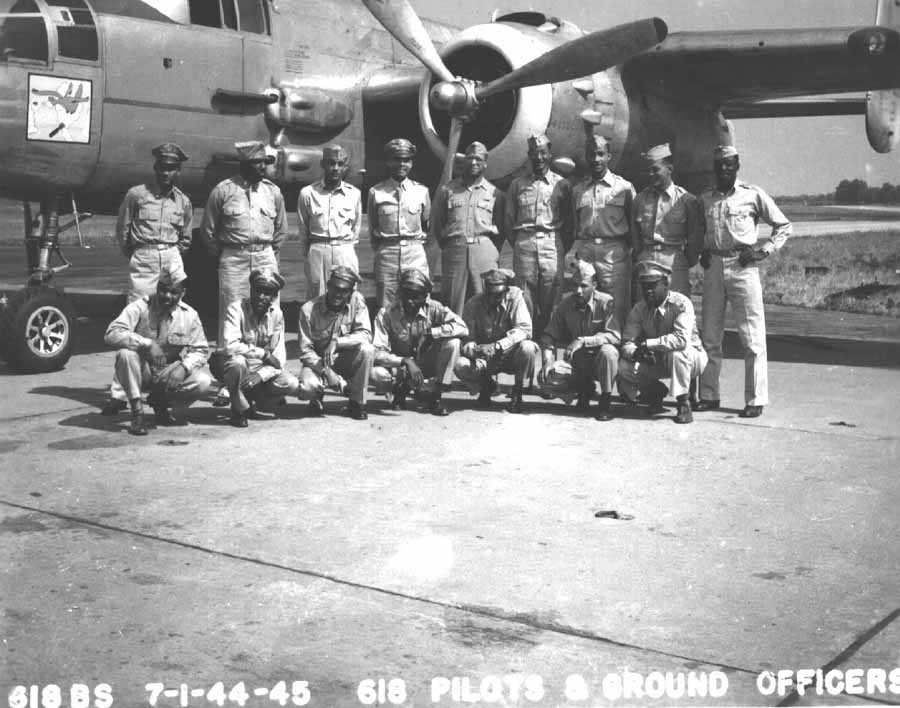
Pilots trained at Tuskegee, some of them by that time seasoned combat veterans as fighter pilots, volunteered to form the nucleus of the 477th Bomber Group. Just as they had proven that African Americans could perform at a high level flying P-47 and P-51 fighters against the best the Luftwaffe could throw at them, they were determined to demonstrate they were just as capable in flying the B-25 Mitchell bomber.
But beyond proving once again the capabilities of African Americans as flyers, these men were also determined to receive the respect due them as officers of the United States Army. And that determination led to some serious clashes with the AAF’s command structure.
The 477th Is Born Under a Segregation Cloud
After an initial false start, the 477th bomber group was reactivated on January 15, 1944, and stationed at Selfridge Field, about 40 miles from Detroit. Problems began almost immediately.
The commander of the 477th was Colonel Robert R. Selway, Jr., a confirmed segregationist. So was Selway’s superior, Major General Frank O’Driscoll Hunter, commander of the First Air Force.
Hunter was determined to maintain strict racial segregation in the units under his command. But he had a problem. In 1940 the Army had issued regulation AR 210-10, which said in part:
No officers club, mess, or other similar social organization of officers will be permitted by the post commander to occupy any part of any public building, other than the private quarters of an officer, unless such club, mess, or other organization extends to all officers on duty at the post the right to full membership, either permanent or temporary, in such club, mess, or organization, including the right equally with any and all other members thereof to participate in the management thereof, in which the officers concerned have an interest.
Under that regulation it was clearly illegal to deny African American officers membership in and use of any officers club on a base where they were stationed. But General Hunter believed he could circumvent the requirements of AR 210-10 and continue his segregationist policies.
Gen. Hunter’s Policy of Segregation Receives a Rebuke
Even before the 477th arrived at Selfridge Field, General Hunter moved to ensure that segregation would be maintained.
There was only one officers club on the base, and Hunter instructed the base commander, Col. William L. Boyd, that the club was to be reserved for Whites only. Hunter promised to have a separate club built for Black officers, but until that happened, they would have to be content with not having access to any officers club.
They were not content.
On January 1, 1944, three Black officers of the 332nd Fighter Group, already stationed at Selfridge before the 477th was activated, entered the officers club and asked to be served. Col. Boyd confronted them and, using racially insulting language, informed them that they were not welcome there. He officially ordered them to leave.
The officers did so. But a later investigation by the War Department determined that Col. Boyd’s actions were in clear violation of AR 210-10. He was officially reprimanded and relieved of his command. The language used in the reprimand was unequivocal:
Investigation by the Office of the Inspector General has disclosed that racial discrimination against colored officers. . . was due to your conduct in denying to colored officers the right to use the Officers Club. . . . Such action is in violation of Army Regulations and explicit War Department instructions on this subject.
As a commissioned officer of the Regular Army of many years standing you must have had knowledge that your conduct in this respect was highly improper. Not only does your conduct indicate a lack of good judgment, but it also tends to bring criticism upon the military service.
You are hereby formally reprimanded and admonished that any future action on your part will result in your being subjected to the severe penalties prescribed by the Articles of War.
General Hunter was dismayed by his subordinate being reprimanded for obeying his orders. But he was not deterred from pursuing his segregation agenda. One reason for his persistence was that despite the official action taken against Col. Boyd, Hunter was being told informally that his superiors, all the way up to General Hap Arnold, approved of his policy. (Significantly, however, the chain of command refused Hunter’s request that they put that approval in writing).
General Hunter Publicly States His Commitment to Segregation
When the first contingent of the 477th’s officers arrived at Selfridge Field to begin training, General Hunter held a briefing to let them know exactly where he stood. He told them:
The War Department is not ready to recognize blacks on the level of social equal to white men. This is not the time for blacks to fight for equal rights or personal advantages. They should prove themselves in combat first. There will be no race problem here, for I will not tolerate any mixing of the races. Anyone who protests will be classed as an agitator, sought out, and dealt with accordingly. This is my base and, as long as I am in command, there will be no social mixing of the white and colored officers. The single Officers Club on base will be used solely by white officers. You colored officers will have to wait until an Officers Club is built for your use. Are there any questions? If there are, I will deal with them personally.
But the officers of the 477th were not intimidated by their commanding general’s unbending stance. Instead, they began developing a plan.
Negroes can’t expect to obtain equality in 200 years, and probably won’t except in some distant future. . . I will not tolerate any mixing of the races and anyone who protests will be classed as an agitator, sought out, and dealt with accordingly.
General Frank Hunter
The 477th Is Moved From Base to Base for Racial Reasons
In June of 1943 the city of Detroit had been the scene of severe race riots which many in the Army command structure, including General Hunter, believed had been fomented by “agitators.” Sensing the unhappiness of Black officers at being subjected to discrimination at Selfridge Field because of their race, General Hunter became concerned that the proximity of the base to Detroit might allow the racial unrest to spread to the 477th.
That led, on May 5, 1944, to the 477th being moved, suddenly and without warning, from Selfridge to Godman Field near Fort Knox, Kentucky. Segregation was easier to maintain at Godman because of its proximity to Fort Knox.
The Black officers assigned to Godman were allowed use of the only officers club on the base. But White officers were officially assigned to Fort Knox, not Godman, and were able to join the exclusively White officers club there.
Godman, however, proved totally unsuited for the training of a bomber group. It had a number of inadequacies, including runways too short to allow B-25s to land. So, starting on March 1, 1945 the 477th was moved once more, this time to Freeman Field in Indiana. The transfer was spread over several weeks, and was scheduled to be completed in early April.
A great advantage of Freeman Field, from the point of view of General Hunter and Colonel Selway, was that it already had two club facilities, one for officers and another for non-commissioned officers. Col. Selway simply dispossessed the non-coms from their club, and designated it for use by the officers of the 477th.
However, Hunter and Selway had learned a lesson from the reprimand given Col. Boyd for his violation of AR 210-10. They needed a way to justify limiting Black officers to the second club while barring them from the first.
The plan they settled on was to designate the first club as being for “permanent” and the second for “temporary” officers on the base (Selway would later change those designations to “supervisors” and “trainees”). They then named all the White instructors as supervisors and all the Black officers as trainees. That would allow them to deny any charge of having a racially discriminatory purpose in mandating the separation of the two groups.
But nobody was fooled. Even Hunter and Selway themselves found it difficult to keep up the pretense – transcripts of their telephone conversations show them sometimes slipping and referring to the “white” officers club.
The officers of the 477th understood perfectly well the subterfuge being practiced by their superior officers, and determined to combat it. They dubbed the club assigned to them “Uncle Tom’s Cabin” and refused to use it.
On April 1, 1945 Col. Selway issued an order officially putting his plan of segregation by dividing “supervisors” from “trainees” into effect.
Black Officers of the 477th Defy Their Commander’s Segregation Policy
Word of Selway’s order quickly made its way back to Godman Field, where the last contingent of 477th officers was preparing for their move to Freeman Field. They immediately began strategizing about how they would combat the illegal segregation that Hunter and Selway had instituted at Freeman.
Under the leadership of Lt. Coleman A. Young, who in 1974 would become the first Black mayor of Detroit, the group developed a plan of non-violent protest.
When this last group of 477th officers arrived at Freeman Field on the afternoon of April 5, 1945, they began putting their strategy into motion that very evening.
As they had planned, the Black officers began going to the White officers club in small groups to request service. They were met by Major Andrew M. White, who was in charge of the club.
After the first group of three was turned away by Maj. White, Lt. Joseph D. Rogers, assigned as Officer of the Day (OOD) and armed with a .45 caliber automatic weapon, was stationed at the entrance. As each group approached, Lt. Rogers ordered them to leave. When they refused to do so, Maj. White placed them under arrest “in quarters.”
Upon being arrested each group of Black officers quietly left the club and returned to their quarters. That night 36 officers were arrested and confined to quarters.
Included in the last group to attempt entrance to the club on the night of the 5th was Lt. Roger C. Terry. The OOD, Lt. Rogers, would later claim that as he attempted to block the Black officers from entering the club, Lt. Terry, as well as two other officers who sought to enter the club that night, jostled him in order to get past him.
The next day additional groups totaling 25 more officers went to the club and were arrested. In all, over the two days of the protest, a total of 61 officers of the 477th were placed under arrest.
The Army Instructs Col. Selway to Release the Arrested Officers
The AAF now had a public relations mess on its hands. An investigation was launched, and the Air Inspector of the First Air Force recommended dropping the charges against most of the officers due to doubts as to whether Col. Selway’s order segregating the clubs had been properly drafted. If the wording of the order was flawed, the arrestees could not be held accountable for violating it.
Most of the officers were released. But Lt. Terry and two others, Lts. Marsden A. Thompson and Shirley R. Clinton, were held on the charge of offering violence (the jostling claimed by Lt. Rogers) to a superior officer.
VIDEO: A student documentary on the 477th
Col. Selway Tries Again to Force Compliance With His Segregation Directive
With his first attempt to enforce segregation having fallen apart, Col. Selway now determined to reissue his order in a form that would allow no escape if the Black officers violated it. On April 9 he published Regulation 85-2, detailing his requirement that “trainees” were not to use the “supervisors” officers club, and had it posted to camp bulletin boards.
To make sure no one could claim to have not seen it, the next day he called an assembly of all the Black officers and had the regulation read to them. They were then ordered to sign a statement affirming that they had read and fully understood the regulation.
The Black officers, believing that Selway’s regulation was illegal and therefore could not be understood as a lawful order, refused to sign. A group meeting was held with fourteen of the officers to try to convince them to sign. Only three of the fourteen did so.
Finally, on the advice of officials of the First Air Force, Col. Selway set up a board having two White and two Black officers. Each officer of the 477th was brought individually before this board and ordered to sign a certification of having read Selway’s regulation.
They were told that they could strike out the words “fully understand,” and even use their own wording in their certification. However, if they continued to refuse to sign after having been ordered to do so, they would be in violation of the 64th Article of War, which relates to disobeying a direct order of a superior officer in time of war. The statutory penalty when convicted of such an infraction was death.
I’d be delighted for them to commit enough actions that way so I can court-martial some of them.
General Frank Hunter
Mutiny! 101 Black Officers Refuse to Obey Their Commander’s Order
Some officers now did sign the certification, many after modifying it with their own wording, or adding a note saying that they were signing under protest. But 101 of the 425 officers of the 477th, convinced that Col. Selway’s regulation was illegal, and determined to no longer bow to the racial discrimination that was being practiced throughout the Army, still refused to sign.
The mass refusal of these officers to obey a direct order from their superior is what has become known as the “Freeman Field Mutiny.”
Back in March, in apparent anticipation that the officers of the 477th might protest against his segregation orders, General Hunter had told Colonel Selway in a telephone conversation, “I’d be delighted for them to commit enough actions that way so I can court-martial some of them.” He now had his wish, and pushed hard to have the Black officers prosecuted under the 64th article of war.
The 101 who refused to sign (they became known as the 101 Club), were placed under arrest and surreptitiously sent back to Godman Field, under guard, to await court martial.
One of the officers, Lt. Leroy Battle, remembers, “They pulled us out of our barracks at 2 or 3 o’clock in the morning. They said ‘We’re going to hang you because you disobeyed a superior officer in a time of war.’”
The 101 arrested officers about to board transports to take them to Godman Field for court martial. Photo taken with a hidden camera to avoid confiscation. Source: Harold J. Beaulieu via Wikipedia (public domain)
The Army Once Again Steps Back From the Brink
Placing more than a hundred African American officers, some of them combat veterans, under threat of death for disobeying an order cooked up to enforce illegal segregation was not a prospect the Army’s brass looked on with the same delight General Hunter seemed to have. The Black press, national civil rights organizations, and a number of members of Congress began to emphatically weigh in.
The Army’s “Advisory Committee on Negro Troop Policy,” headed by Assistant Secretary of War John J. McCloy, began an investigation. Although the AAF Inspector General produced a report backing Col. Selway, claiming that his regulation 85-2 was consistent with War Department policy, the McCloy Committee was not impressed. The sole African American member of the committee, Truman K. Gibson, Civilian Aide to the Secretary of War, described the AAF’s report as “a fabric of deception and subterfuge.”
The committee reported to Secretary of War Henry L. Stimson that Selway’s actions were “not in accord with existing Army regulations,” and recommended that his “non-concurrence with Army regulations and war department policies be brought to the attention of the Commanding General, Army Air Forces, for appropriate action.”
Finally, on April 19, 1945, General George C. Marshall, the armed forces Chief of Staff, ordered the 101 released. He did allow General Hunter to place administrative reprimands in each of their records.
However, the three officers accused of “jostling” a superior officer during the officers club demonstration, Lts. Terry, Thompson, and Clinton, were not released. Instead, they were subjected to court martial.
But by the time the trials of the three took place, the AAF had already begun to take corrective action. Col. Selway was relieved of command of the 477th, replaced by Lt. Col. Benjamin O. Davis, Jr., a tested combat leader, and the first African American graduate of West Point in the 20th century.
(By the way, at West Point Davis had endured four years of silence. None of the other cadets would so much as speak to him outside the requirements of official duty during that entire time).
The 477th was returned to Godman Field, where the entire chain of command was replaced by Black officers under Col. Davis.
With the new command structure at Godman Field, the court that would try the three men accused of jostling a superior would consist entirely of Black officers.
Three Officers Are Court-Martialed
The accused officers did not lack for fire power on their defense team. The defense was directed by future Supreme Court justice Thurgood Marshall (though he did not appear at the trial). The on-site defense team was led by Theodore M. Berry, a future mayor of Cincinnati, assisted by Chicago lawyer Harold Tyler, and Lt. William T. Coleman, Jr., a future U. S. Secretary of Transportation under President Gerald Ford.
It was determined that Lts. Clinton and Thompson would be tried together, while Lt. Terry would be tried separately.
When the Clinton/Thompson trial commenced on July 2, 1945, the prosecution’s case quickly began to flounder.
That case wasn’t helped by the attitude of Col. Selway, who appeared as a prosecution witness. He started by refusing to salute the court (which consisted of Black officers) as tradition required, directing his salute instead to the flag. He continued to behave in a disrespectful and insolent manner throughout his testimony.
The prosecution failed to establish that the order given by Lt. Rogers in his attempt to bar the Black officers from the club was a legal order. In fact, they were unable to prove that Lt. Rogers had actually ordered the men to not enter the club.
Several eyewitnesses testified that the accused officers never touched Lt. Rogers during their confrontation. Lts. Clinton and Thompson were acquitted of all charges.
Lt. Terry was not quite as fortunate. In a separate trial conducted the next day, the court acquitted him of disobeying a lawful order from a superior officer. However, it convicted him on the jostling charge. Lt. Terry was sentenced to forfeiture of $150 in pay, loss of rank, and a dishonorable discharge from the service.
General Hunter considered that punishment “grossly inadequate,” but was forced to approve it.
The 477th Wins Its Battle
With all the upheaval it had gone through, the 477th’s training had been set back so much that by the time the Bomber Group was scheduled for deployment, the war had ended.
The 477th never saw combat overseas. But it won one of the most consequential battles of the war right here at home.
Three years after the “mutiny” at Freeman Field, on July 26, 1948, President Harry S. Truman issued Executive Order 9981 forbidding racial discrimination throughout the military of the United States.
It took, however, a little longer for the Air Force to right the wrongs done to the officers who put their careers, and indeed their lives, on the line to demand that the American military live out the creed for which it claimed to be fighting.
The Air Force Finally Corrects Its Mistake
In August of 1995, the Air Force began to remove, upon request, General Hunter’s letters of reprimand from the permanent files of the officers charged at Freeman Field.
Lt. Terry received a full pardon for his court martial conviction, and had his rank and the fine he had paid restored to him. There is now a square named for him in his home town of Los Angeles.
In announcing the reversal of the actions taken against these men in 1945, Air Force Assistant Secretary Rodney Coleman said:
The 104 officers involved in the so-called “mutiny” have lived the last 50 years knowing they were right in what they did – yet feeling the stigma of an unfair stain on their records because they were American fighting men, too – and wanted to be treated as such.
On March 29, 2007 the officers of the 477th, along with other members of the Tuskegee Airmen, were presented with the Congressional Gold Medal by President George W. Bush.
How the GOP fails to appeal to Black conservatives. Source: Used with permission of Microsoft
After President Barack Obama won reelection in 2012, the Republican Party did a lot of soul-searching. It was very clear that demographic trends among the American electorate were putting the future of the party at risk. As South Carolina GOP Senator Lindsey Graham famously told the Washington Post, “We’re not generating enough angry white guys to stay in business for the long term.”
For the past half-century, the base of the Republican Party has been overwhelmingly white. In the 2012 election, the GOP candidate, Mitt Romney, won 59% of the white vote (39% voted for his Democratic opponent, Barack Obama). However, the incumbent president won the election by amassing 93% of the African American vote as well as 71% of the Latino vote and 73% of the Asian vote.
In the aftermath of that devastating defeat (President Obama won 332 electoral votes to just 206 for Romney), the Republicans conducted an “autopsy” to determine the causes of their loss and to give recommendations for rectifying those problems going forward.
The autopsy report, entitled “Growth & Opportunity Project,” noted that the percentage of whites in the electorate is shrinking year by year. The report concluded that if the GOP hopes to win presidential elections in the future, it must find ways of attracting more minority voters.
The Republican Party must be committed to building a lasting relationship within the African American community year-round, based on mutual respect and with a spirit of caring.
— 2013 GOP “autopsy” report
But that clearly hasn’t happened.
Although in 2024 Donald Trump managed to garner 15% of the Black vote, according to a 2024 Pew Research Center report, only 12% of African Americans self-identify as Republicans.
A Significant Number of African Americans Hold Conservative Views
According to a 2020 Gallup poll, 22% of African Americans describe themselves as conservative, compared to the 40% of the general population who make the same declaration. However, the number who hold conservative beliefs may be far higher. As a 2025 article published by the Stanford University Center on Democracy, Development and the Rule of Law (CDDRL) notes, many African Americans are unfamiliar with the terms “liberal” and “conservative” and don’t use them concerning their views. So it’s likely that far more than 22% of African Americans hold conservative beliefs.
For example, when it comes to hot-button moral issues such as abortion and same-sex marriage, polls indicate that the views of African Americans are more conservative than those of the population as a whole. The Stanford CDDRL article asserts that “according to national surveys, up to 50 percent of Black Americans describe themselves as conservative.”
Yet, while white conservatives identify strongly with the Republican Party, very few African Americans do. Why is there such an aversion, even antipathy, among the vast majority of African Americans toward the GOP?
Why Don’t Conservative African Americans Support the GOP?
Let’s be frank: many African Americans are convinced that the Republican Party is racist to its core. GOP leaders, of course, vigorously deny that charge. But the historical roots of that perception are well documented.
For decades after Emancipation, African Americans voted (when they were allowed to vote) almost exclusively for Republicans. After all, Abraham Lincoln, the first Republican president, had been instrumental in ending slavery. And in the years immediately following his death, the Republican Party worked hard to secure civil and voting rights for blacks.
The Democrats, on the other hand, were the party of racial bigotry and white supremacy. Before and even during the Civil War, the Democratic Party supported slavery. After the war, they worked to legalize and institutionalize racial discrimination and segregation throughout the nation. Understandably, “black Democrat” was a contradiction in terms.
But the GOP’s response to the Civil Rights revolution of the mid-20th century turned African Americans’ allegiance around. Because of GOP policies and actions that were initiated during that period (which continue today), many African Americans came to the conclusion that the Republican Party was not one in which they could feel welcomed and valued.
The Presidential Election of 1964 Drove Millions of African Americans From the GOP
The event that caused the most precipitous drop in black allegiance to the Republican Party was the presidential election of 1964. The GOP candidate that year was Senator Barry Goldwater of Arizona.
Goldwater was far from racist himself. He was a founding member of the Arizona NAACP and had helped to integrate the Arizona National Guard. He declared himself to be “unalterably opposed to discrimination or segregation on the basis of race, color, or creed.” But, due to his conservative states-rights principles, he felt compelled to vote against the Civil Rights Act of 1964, considering it to represent a dangerous intrusion into state affairs by the federal government.
Once enacted, the 1964 Civil Rights Act (along with the Voting Rights Act of 1965) completely transformed race relations in the United States. African Americans, both then and now, consider it to be one of the most consequential pieces of legislation in American history. The GOP presidential candidate’s conservative opposition to this seminal measure caused African Americans to leave the Republican Party in droves.
In the 1960 presidential race, 32% of African Americans voted for the Republican candidate Richard Nixon. Just four years later, in 1964, only 6% of black voters cast their ballots for Barry Goldwater. Since that time, no Republican presidential candidate has received more than 17% of the black vote.
The Republicans Become an Almost All-White Party
Even Richard Nixon recognized and lamented the direction in which Goldwater was taking the GOP. “If Goldwater wins his fight,” Nixon told Ebony magazine in 1962, “our party would eventually become the first major all-white political party.” Although he himself would eventually move in the same direction, Nixon’s comment was prescient. More than a half-century later, the GOP remains an almost exclusively white party.
If Goldwater wins his fight, our party would eventually become the first major all-white political party.— Richard Nixon in 1962
The GOP Initiates a Southern Strategy
Although some Republican politicians and operatives may not have been personally racist, they were quite willing to pander to racists for political advantage.
Recognizing that Southern Democrats were very unhappy with their party’s growing support of civil rights for African Americans, GOP leaders made a deliberate decision to go after those votes. Goldwater himself said, “We’re not going to get the Negro vote as a bloc in 1964 and 1968, so we ought to go hunting where the ducks are.”
In a 1981 interview, high-level GOP operative Lee Atwater, a major architect of the Southern Strategy, explained how it worked:
“You start out in 1954 by saying, ‘N*****, n*****, n*****.’ By 1968 you can’t say ‘n*****’ — that hurts you, backfires. So you say stuff like, uh, forced busing, states’ rights, and all that stuff, and you’re getting so abstract. Now, you’re talking about cutting taxes, and all these things you’re talking about are totally economic things and a byproduct of them is, blacks get hurt worse than whites.”
After attending a meeting of the Republican National Committee in the summer of 1963, conservative journalist Robert Novak reported on the thinking of many party leaders: “A good many, perhaps a majority of the party’s leadership, envision substantial political gold to be mined in the racial crisis by becoming in fact, though not in name, the White Man’s Party.”
The Southern Strategy successfully encouraged whites who harbored racial resentments to leave the Democratic Party and join the GOP. When he signed the 1964 Civil Rights bill into law, President Lyndon Johnson commented that his doing so would cause the Democrats to lose the South for a generation. He was wrong. It’s been far longer than a single generation, and the South remains overwhelmingly Republican to this day.
The Southern Strategy Continues
As most African Americans see it, the Republican Party has never given up on its Southern Strategy and continues to follow it today. The necessity of placating the constituency brought into the party by that strategy has, in the view of millions of African Americans, turned the GOP into an institution that is very tolerant of veiled racism in its ranks.
Think, for example, of the kind of language African Americans have heard from Republican politicians over the last several decades.
In 1976 Ronald Reagan energized his campaign for president by bringing the term “welfare queen” into the popular consciousness. Since many whites associated welfare with poor black people, Reagan’s use of that term came across to African Americans, then and now, as a dog whistle appeal to whites who were beset by racial resentments.
In 1988 a political action committee supporting George H. W. Bush, whose campaign manager was the aforementioned Lee Atwater of “N*****, n*****, n*****” fame, ran ads that accused Bush’s opponent, Massachusetts Gov. Michael Dukakis, of having released on furlough a felon who went on to re-offend. That felon’s name was Willie Horton, and his mug shot photo was prominently featured in the ad. No one missed the fact that Willie Horton was black.
With the 2008 election and the 2012 reelection of Barack Obama as the country’s first president of African American heritage, Republican candidates and their surrogates used language that came across to African Americans as extremely demeaning and disrespectful.
For example, former Republican Speaker of the House Newt Gingrich became a rich source of quotes that played well to the Republican base but which deeply offended African Americans:
“[Obama] is the best food stamp president in history.”
“This is a person who is fundamentally out of touch with how the world works, who happened to have played a wonderful con, as a result of which he is now president.”
“And so I’m prepared, if the NAACP invites me, I’ll go to their convention and talk about why the African-American community should demand paychecks and not be satisfied with food stamps.”
Former New Hampshire governor John Sununu, a surrogate for 2012 GOP nominee Milt Romney, expressed his sentiments about the first African American president with the following language: “I wish this president would learn how to be an American.” And when Obama appeared ill-prepared in his first debate with Romney, Sununu knew exactly where the president’s problem lay: “When you’re not that bright you can’t get better prepared.”
The culmination of what most African Americans perceive as a torrent of disrespect aimed at their race by Republicans is embodied in Donald Trump. Trump rose to political prominence by demanding that President Obama produce his birth certificate to prove that he is an American. Then, as the 2016 GOP presidential candidate, Trump began speaking to almost exclusively white audiences about his conception of the problems faced by African Americans, using language many blacks perceived as highly patronizing.
For most African Americans, episodes like these (and many more that could be cited) are evidence that the Southern Strategy remains alive and well in the Republican Party.
Even Some Black Republicans Are Concerned About Racism in Their Party
One high-profile black Republican was particularly blunt in calling out his party for their attitudes toward racial minorities. In an appearance on NBC’s Meet the Press, former Secretary of State Colin Powell said: “There’s also a dark vein of intolerance in some parts of the party. What do I mean by that? What I mean by that is they still sort of look down on minorities.”
Rather than listening to and learning from Powell’s critique, most Republicans responded with outrage: “I think the case that he makes is weak, and it is an odd thing for a man who declares himself to be a Republican—and has done so well under Republican presidents—to say,” intoned conservative commentator Britt Hume on Fox News. Another Fox News show featured a panel discussing the issue against a backdrop proclaiming that Colin Powell was “unhinged.”
In no case did any Republicans of note ask to sit down with Colin Powell to gain some insight into how African Americans view their party. J. C. Watts, an African American who is a former GOP Congressman from Oklahoma and a former chairman of the Republican Conference, stated that his party was “in denial” about how it is perceived by minority voters.
Perceptions of GOP Voter Suppression Increase African American Distrust of the Party
Speaking to the 2013 state convention of the North Carolina Republican Party, Watts noted that although many blacks are no longer enamored with the Democratic Party, they still are not becoming Republicans. “They just don’t trust us,” he said.
A major factor in that growing distrust is the efforts of various Republican governors and state legislatures to enact voter ID laws and other measures that African Americans perceive as being aimed directly at suppressing the black vote. Well aware that none of the states that have enacted ID laws can point to any substantial amount of voter fraud that would be corrected by such legislation, African Americans are almost unanimous in their belief that the only purpose for these measures is to make it harder for blacks to vote.
And the courts are beginning to agree. In its 2016 ruling striking down North Carolina’s voter ID law, a federal appeals court took the GOP-dominated legislature to task for enacting a law that was intentionally designed to discourage blacks from voting:
“The evidence in this case establishes that, at least in part, race motivated the North Carolina legislature. . . Although the new provisions target African Americans with almost surgical precision, they constitute inapt remedies for the problems assertedly justifying them and, in fact, impose cures for problems that did not exist.” (Emphasis added)
Can the Republican Party Ever Attract Significant Numbers of African Americans?
Unless it changes significantly, the Republican Party as it exists today will never be able to provide a welcoming political home for African Americans. Even among black conservatives whose outlook should make them a natural fit for the GOP, the level of distrust is simply too great.
A Black man voting for the Republicans makes about as much sense as a chicken voting for Col. Sanders.
J.C. “Buddy” Watts Sr., father of former Republican congressman J.C. Watts
Attracting black people would require that GOP leaders—elected officials and candidates—significantly change their messaging to the base they have courted and depended upon since the start of the Southern Strategy a half-century ago. As long as African Americans perceive that many statements and policies put forward by GOP leaders carry a hidden meaning intended to appease people who are resentful of minorities, most blacks will continue to view the Republican Party as more enemy than friend.
What’s required is the kind of courageous statesmanship that is willing to speak the truth to constituents rather than pander to their prejudices. But true statesmen are always rare in any political party. Most politicians, both Democrats and Republicans, have their eyes fixed no further ahead than the next election. But for the Republican Party, politics, as usual, will never draw African Americans into the fold.
And that’s a shame. Republicans are fond of pointing out that the overwhelming affinity of black voters for the Democratic Party allows the Democrats to take them for granted. That’s one GOP message many African Americans would agree with.
We Need to Have More African Americans in the Republican Party
This country needs many more African Americans to find a political home in the GOP so that there can be real competition between the parties for black votes. I sincerely hope Republicans can find a way to start putting forward policy positions and campaign messaging that genuinely invite African Americans into the party rather than driving them away.




Recent Comments