Little known but inspirational stories from Black history

Category: African American Military History

Eleanor Roosevelt’s Historic Flight With a Tuskegee Airman

Eleanor Roosevelt. Source: Wikimedia (CC BY 2.0)

Eleanor Roosevelt was a woman of conviction and courage. In 1941, she demonstrated both by climbing into the back seat of a J-3 Piper Cub and going up for a flight with an African American pilot at the controls. This was during a time when most Americans were convinced that Blacks had neither the physical nor mental capacity to safely fly airplanes.

A Visit to Tuskegee

As the wife of President Franklin Delano Roosevelt, Eleanor Roosevelt became well known for her concern for the civil rights of African Americans. She did all she could to demonstrate to a skeptical nation that its Black population was just as intelligent and capable as other Americans and deserved all the rights and privileges of citizenship. In 1941, she found an opportunity to reinforce that conviction in a dramatic fashion.

In March of that year, the First Lady visited the Tuskegee Institute in Alabama to meet fellow trustees of the Julius Rosenwald Fund. The Institute was founded in 1881 by Booker T. Washington and, with famed agricultural scientist Dr. George Washington Carver in residence, had a stellar reputation for its programs to improve educational opportunities and the quality of life for Blacks and other disadvantaged people.

Because she was concerned for the welfare of the nation’s Black population, the First Lady had a great interest in the various projects Tuskegee Institute was carrying out. One of these that stirred her interest was the aeronautical school in operation there. In 1939, Congress established the Civilian Pilot Training Program at colleges and universities around the country. Hard-fought efforts by African-American activists resulted in six historically Black colleges, Tuskegee among them, being included in the program.

Tuskegee Becomes the Training Site for Black Military Pilots

Because of its outstanding record with the civilian flight program, in January of 1941, the War Department selected Tuskegee to be the pilot training base for the newly formed 99th Pursuit Squadron.

This would start the “experiment” in Black military aviation, producing the acclaimed Tuskegee Airmen. But to implement the plan, Tuskegee needed to find funding to bring its airfield up to the required standard. It was to consider that need that Mrs. Roosevelt and the other Julius Rosenwald Fund trustees assembled at the school.

The First Lady Goes for a Flight With a Black Pilot

On March 29, 1941, Mrs. Roosevelt visited Tuskegee’s airfield, where she met Charles Alfred “Chief” Anderson, the head of the civilian pilot training program and its chief flight instructor. Anderson was the first and, at that time, only African American pilot to have received his commercial transport license.

This future leader of the Tuskegee Airmen had begun making his mark on aviation as early as 1933, when he and another pioneer aviator, Dr. Albert E. Forsythe, became the first African Americans to complete a transcontinental flight from Atlantic City to Los Angeles and back. But now, he was about to make what, from a historical perspective, was perhaps the most impactful flight of his career.

Mrs. Roosevelt and C. Alfred "Chief" Anderson in the plane
Mrs. Roosevelt and C. Alfred “Chief” Anderson in the plane
Source: U.S. Air Force via Wikimedia Commons (public domain)

According to J. Todd Moye in his book Freedom Flyers: The Tuskegee Airmen of World War II, Mrs. Roosevelt observed to Anderson that everybody had told her Black people couldn’t fly airplanes. She then asked if he would take her up for an aerial tour.

The First Lady’s Secret Service escort, of course, went apoplectic. But Eleanor Roosevelt was nothing if not stubborn when she had a worthy end in mind. So, up they went, for the better part of an hour. It was certainly the first time in history that a First Lady of the United States flew with a Black man at the controls.

Anderson remembers that they had a delightful flight, which Mrs. Roosevelt enjoyed very much. When they landed, she told him, “Well, you can fly, alright.”

In March of 2014, C. Alfred “Chief” Anderson was honored by being featured on a U. S. postage stamp. The 70-cent First-Class stamp is the 15th in the Postal Service’s Distinguished American Series. In its announcement, the Postal Service celebrated Chief Anderson as “The Father of Black Aviation” and “the Charles Lindbergh of Black Aviation.”

Mrs. Roosevelt’s Uses Her Flight to Educate the American Public

It’s clear that from the beginning of this adventure, Mrs. Roosevelt knew exactly what she was doing. According to the Eleanor Roosevelt Papers Project at George Washington University, she insisted that her flight with pilot Anderson be photographed, and the film developed immediately so she could take it back to Washington with her.

The photograph appeared in papers across the country, and Mrs. Roosevelt described the flight in a paragraph in her weekly newspaper column, My Day, saying, “These boys are good pilots.” As Moye notes, for millions of her readers, this would be the first time they became aware of Blacks flying airplanes and doing it well.

Mrs. Roosevelt Uses Her Flight to Influence FDR

But beyond the visibility the photograph brought to the public, Mrs. Roosevelt also had another audience in mind. That audience consisted of only one person. It was, of course, her husband, Franklin Delano Roosevelt, President of the United States. The Eleanor Roosevelt Papers Project says she later used that photograph to persuade FDR to allow the Tuskegee Airmen to be deployed in the war’s North Africa and European Theaters.

She also used her influence as a Julius Rosenwald Fund trustee to have that organization appropriate a loan to help Tuskegee bring its airfield up to required military standards.

Tuskegee Airmen, 1942-43
Tuskegee Airmen, 1942-43.
Source: U.S. Air Force via Wikimedia Commons (public domain)

A Lasting Legacy

For at least two decades, African Americans who wanted to serve as military aviators had been stymied by a brick wall of prejudice and intolerance. Eleanor Roosevelt was committed to doing everything she could to change that. She exerted considerable influence with funders, the public, and her husband, the President of the United States, to bring about the needed change.

Mrs. Roosevelt’s flight with “Chief” Anderson was a big first step in establishing the reputation of the Tuskegee Airmen in the public mind and allowing them to achieve the outstanding combat record they earned during World War II. That, in turn, was an important factor in President Harry Truman’s 1948 executive order abolishing racial discrimination throughout the American military.

In a very real way, the effects of Eleanor Roosevelt’s flight into history still resonate today.

© 2013 Ronald E. Franklin

Eleanor Roosevelt was a woman of conviction and courage. In 1941, she demonstrated both by climbing into the back seat of a J-3 Piper Cub and going up for a flight with an African American pilot at the controls. This was during a time when most Americans were convinced that Blacks had neither the physical nor mental capacity to safely fly airplanes.

A Visit to Tuskegee

As the wife of President Franklin Delano Roosevelt, Eleanor Roosevelt became well known for her concern for the civil rights of African Americans. She did all she could to demonstrate to a skeptical nation that its Black population was just as intelligent and capable as other Americans and deserved all the rights and privileges of citizenship. In 1941, she found an opportunity to reinforce that conviction in a dramatic fashion.

In March of that year, the First Lady visited the Tuskegee Institute in Alabama to meet fellow trustees of the Julius Rosenwald Fund. The Institute was founded in 1881 by Booker T. Washington and, with famed agricultural scientist Dr. George Washington Carver in residence, had a stellar reputation for its programs to improve educational opportunities and the quality of life for Blacks and other disadvantaged people.

Because she was concerned for the welfare of the nation’s Black population, the First Lady had a great interest in the various projects Tuskegee Institute was carrying out. One of these that stirred her interest was the aeronautical school in operation there. In 1939, Congress established the Civilian Pilot Training Program at colleges and universities around the country. Hard-fought efforts by African-American activists resulted in six historically Black colleges, Tuskegee among them, being included in the program.

Tuskegee Becomes the Training Site for Black Military Pilots

Because of its outstanding record with the civilian flight program, in January of 1941, the War Department selected Tuskegee to be the pilot training base for the newly formed 99th Pursuit Squadron.

This would start the “experiment” in Black military aviation, producing the acclaimed Tuskegee Airmen. But to implement the plan, Tuskegee needed to find funding to bring its airfield up to the required standard. It was to consider that need that Mrs. Roosevelt and the other Julius Rosenwald Fund trustees assembled at the school.

The First Lady Goes for a Flight With a Black Pilot

On March 29, 1941, Mrs. Roosevelt visited Tuskegee’s airfield, where she met Charles Alfred “Chief” Anderson, the head of the civilian pilot training program and its chief flight instructor. Anderson was the first and, at that time, only African American pilot to have received his commercial transport license.

This future leader of the Tuskegee Airmen had begun making his mark on aviation as early as 1933, when he and another pioneer aviator, Dr. Albert E. Forsythe, became the first African Americans to complete a transcontinental flight from Atlantic City to Los Angeles and back. But now, he was about to make what, from a historical perspective, was perhaps the most impactful flight of his career.

Mrs. Roosevelt and C. Alfred "Chief" Anderson in the plane
Mrs. Roosevelt and C. Alfred “Chief” Anderson in the plane
Source: U.S. Air Force via Wikimedia Commons (public domain)

According to J. Todd Moye in his book Freedom Flyers: The Tuskegee Airmen of World War II, Mrs. Roosevelt observed to Anderson that everybody had told her Black people couldn’t fly airplanes. She then asked if he would take her up for an aerial tour.

The First Lady’s Secret Service escort, of course, went apoplectic. But Eleanor Roosevelt was nothing if not stubborn when she had a worthy end in mind. So, up they went, for the better part of an hour. It was certainly the first time in history that a First Lady of the United States flew with a Black man at the controls.

Anderson remembers that they had a delightful flight, which Mrs. Roosevelt enjoyed very much. When they landed, she told him, “Well, you can fly, alright.”

In March of 2014, C. Alfred “Chief” Anderson was honored by being featured on a U. S. postage stamp. The 70-cent First-Class stamp is the 15th in the Postal Service’s Distinguished American Series. In its announcement, the Postal Service celebrated Chief Anderson as “The Father of Black Aviation” and “the Charles Lindbergh of Black Aviation.”

Mrs. Roosevelt’s Uses Her Flight to Educate the American Public

It’s clear that from the beginning of this adventure, Mrs. Roosevelt knew exactly what she was doing. According to the Eleanor Roosevelt Papers Project at George Washington University, she insisted that her flight with pilot Anderson be photographed, and the film developed immediately so she could take it back to Washington with her.

The photograph appeared in papers across the country, and Mrs. Roosevelt described the flight in a paragraph in her weekly newspaper column, My Day, saying, “These boys are good pilots.” As Moye notes, for millions of her readers, this would be the first time they became aware of Blacks flying airplanes and doing it well.

Mrs. Roosevelt Uses Her Flight to Influence FDR

But beyond the visibility the photograph brought to the public, Mrs. Roosevelt also had another audience in mind. That audience consisted of only one person. It was, of course, her husband, Franklin Delano Roosevelt, President of the United States. The Eleanor Roosevelt Papers Project says she later used that photograph to persuade FDR to allow the Tuskegee Airmen to be deployed in the war’s North Africa and European Theaters.

She also used her influence as a Julius Rosenwald Fund trustee to have that organization appropriate a loan to help Tuskegee bring its airfield up to required military standards.

Tuskegee Airmen, 1942-43
Tuskegee Airmen, 1942-43.
Source: U.S. Air Force via Wikimedia Commons (public domain)

A Lasting Legacy

For at least two decades, African Americans who wanted to serve as military aviators had been stymied by a brick wall of prejudice and intolerance. Eleanor Roosevelt was committed to doing everything she could to change that. She exerted considerable influence with funders, the public, and her husband, the President of the United States, to bring about the needed change.

Mrs. Roosevelt’s flight with “Chief” Anderson was a big first step in establishing the reputation of the Tuskegee Airmen in the public mind and allowing them to achieve the outstanding combat record they earned during World War II. That, in turn, was an important factor in President Harry Truman’s 1948 executive order abolishing racial discrimination throughout the American military.

In a very real way, the effects of Eleanor Roosevelt’s flight into history still resonate today.

Further Reading:

© 2013 Ronald E. Franklin

The Freeman Field Mutiny: How Tuskegee Airmen Challenged Segregation in World War II

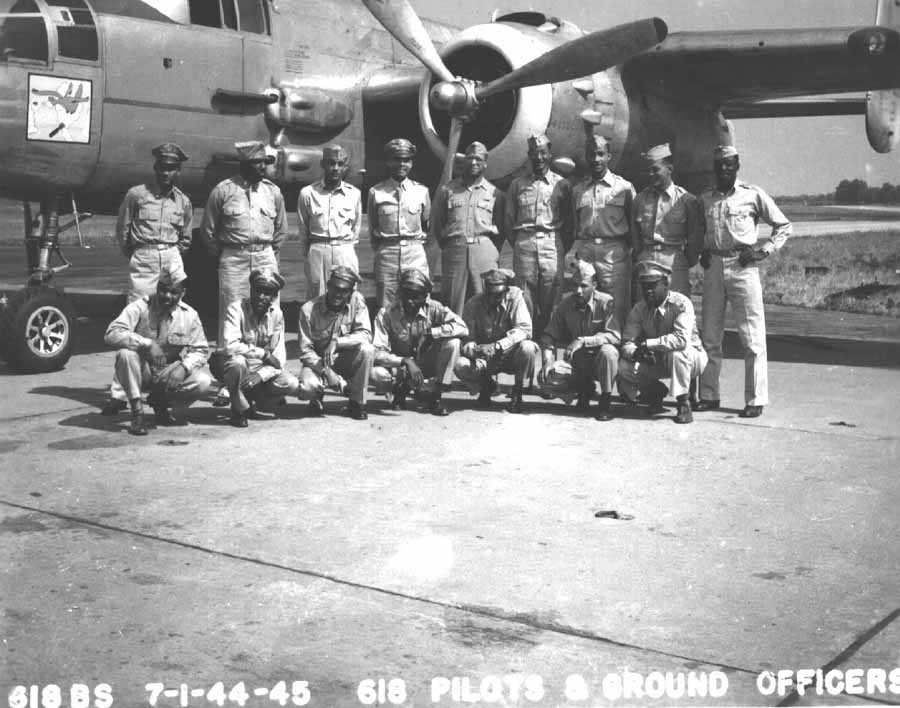
Pilots and ground officers of the 477th with one of their B-25 bombers
Source: United States Army Air Forces (public domain)

What Was the Freeman Field Mutiny?

In April 1945, 101 African American officers of the U.S. Army Air Force’s 477th Bombardment Group were arrested at Freeman Field in Indiana and charged with violations under the 64th Article of War. The maximum penalty for their alleged crimes during time of war was death.

The Unit the Army Didn’t Want But Couldn’t Avoid

The Army never wanted the 477th Bombardment Group in the first place. In fact, the commander of the Army Air Forces (AAF), General Henry (Hap) Arnold, did his best to kill the unit before it got started. But the political pressure was just too great.

That was because the 477th would be the first bomber unit in the United States military to be staffed by African American crews. It was born out of President Franklin D. Roosevelt’s need to shore up his support among Black voters in the 1940 elections.

After persistent and growing public pressure from the Black press, organizations like the NAACP, and from Roosevelt’s own wife, Eleanor, the president and Congress authorized the inclusion of African Americans in military aviation training programs.

That led to the establishment of a flying school at Tuskegee University in Alabama. Graduates of the training program there, the famous Tuskegee Airmen, went on to compile a stellar record flying fighter planes during World War II.

But even while the Tuskegee Airmen fighter pilots, like those of the 332nd Fighter Group (the famed Red Tails), were winning Distinguished Unit Citations in the skies over Europe, no African Americans had been accepted to fly bombers. The 477th was created to correct that omission.

Members of Tuskegee Class 43-B
Source: U.S. Air Force Historical Research Agency (public domain)

Pilots trained at Tuskegee, some of them by that time seasoned combat veterans as fighter pilots, volunteered to form the nucleus of the 477th Bomber Group. Just as they had proven that African Americans could perform at a high level flying P-47 and P-51 fighters against the best the Luftwaffe could throw at them, they were determined to demonstrate they were just as capable in flying the B-25 Mitchell bomber.

But beyond proving once again the capabilities of African Americans as flyers, these men were also determined to receive the respect due them as officers of the United States Army. And that determination led to some serious clashes with the AAF’s command structure.

The 477th Is Born Under a Segregation Cloud

After an initial false start, the 477th bomber group was reactivated on January 15, 1944, and stationed at Selfridge Field, about 40 miles from Detroit. Problems began almost immediately.

The commander of the 477th was Colonel Robert R. Selway, Jr., a confirmed segregationist. So was Selway’s superior, Major General Frank O’Driscoll Hunter, commander of the First Air Force.

Hunter was determined to maintain strict racial segregation in the units under his command. But he had a problem. In 1940 the Army had issued regulation AR 210-10, which said in part:

No officers club, mess, or other similar social organization of officers will be permitted by the post commander to occupy any part of any public building, other than the private quarters of an officer, unless such club, mess, or other organization extends to all officers on duty at the post the right to full membership, either permanent or temporary, in such club, mess, or organization, including the right equally with any and all other members thereof to participate in the management thereof, in which the officers concerned have an interest.

Under that regulation it was clearly illegal to deny African American officers membership in and use of any officers club on a base where they were stationed. But General Hunter believed he could circumvent the requirements of AR 210-10 and continue his segregationist policies.

Major General Frank O. Hunter
Major General Frank O. Hunter.
Source: USAAF via Wikipedia (public domain)

Gen. Hunter’s Policy of Segregation Receives a Rebuke

Even before the 477th arrived at Selfridge Field, General Hunter moved to ensure that segregation would be maintained.

There was only one officers club on the base, and Hunter instructed the base commander, Col. William L. Boyd, that the club was to be reserved for Whites only. Hunter promised to have a separate club built for Black officers, but until that happened, they would have to be content with not having access to any officers club.

They were not content.

On January 1, 1944, three Black officers of the 332nd Fighter Group, already stationed at Selfridge before the 477th was activated, entered the officers club and asked to be served. Col. Boyd confronted them and, using racially insulting language, informed them that they were not welcome there. He officially ordered them to leave.

The officers did so. But a later investigation by the War Department determined that Col. Boyd’s actions were in clear violation of AR 210-10. He was officially reprimanded and relieved of his command. The language used in the reprimand was unequivocal:

  1. Investigation by the Office of the Inspector General has disclosed that racial discrimination against colored officers. . . was due to your conduct in denying to colored officers the right to use the Officers Club. . . . Such action is in violation of Army Regulations and explicit War Department instructions on this subject.
  2. As a commissioned officer of the Regular Army of many years standing you must have had knowledge that your conduct in this respect was highly improper. Not only does your conduct indicate a lack of good judgment, but it also tends to bring criticism upon the military service.
  3. You are hereby formally reprimanded and admonished that any future action on your part will result in your being subjected to the severe penalties prescribed by the Articles of War.

General Hunter was dismayed by his subordinate being reprimanded for obeying his orders. But he was not deterred from pursuing his segregation agenda. One reason for his persistence was that despite the official action taken against Col. Boyd, Hunter was being told informally that his superiors, all the way up to General Hap Arnold, approved of his policy. (Significantly, however, the chain of command refused Hunter’s request that they put that approval in writing).

General Hunter Publicly States His Commitment to Segregation

When the first contingent of the 477th’s officers arrived at Selfridge Field to begin training, General Hunter held a briefing to let them know exactly where he stood. He told them:

The War Department is not ready to recognize blacks on the level of social equal to white men. This is not the time for blacks to fight for equal rights or personal advantages. They should prove themselves in combat first. There will be no race problem here, for I will not tolerate any mixing of the races. Anyone who protests will be classed as an agitator, sought out, and dealt with accordingly. This is my base and, as long as I am in command, there will be no social mixing of the white and colored officers. The single Officers Club on base will be used solely by white officers. You colored officers will have to wait until an Officers Club is built for your use. Are there any questions? If there are, I will deal with them personally.

But the officers of the 477th were not intimidated by their commanding general’s unbending stance. Instead, they began developing a plan.

Negroes can’t expect to obtain equality in 200 years, and probably won’t except in some distant future. . . I will not tolerate any mixing of the races and anyone who protests will be classed as an agitator, sought out, and dealt with accordingly.

General Frank Hunter

The 477th Is Moved From Base to Base for Racial Reasons

In June of 1943 the city of Detroit had been the scene of severe race riots which many in the Army command structure, including General Hunter, believed had been fomented by “agitators.” Sensing the unhappiness of Black officers at being subjected to discrimination at Selfridge Field because of their race, General Hunter became concerned that the proximity of the base to Detroit might allow the racial unrest to spread to the 477th.

That led, on May 5, 1944, to the 477th being moved, suddenly and without warning, from Selfridge to Godman Field near Fort Knox, Kentucky. Segregation was easier to maintain at Godman because of its proximity to Fort Knox.

The Black officers assigned to Godman were allowed use of the only officers club on the base. But White officers were officially assigned to Fort Knox, not Godman, and were able to join the exclusively White officers club there.

Godman, however, proved totally unsuited for the training of a bomber group. It had a number of inadequacies, including runways too short to allow B-25s to land. So, starting on March 1, 1945 the 477th was moved once more, this time to Freeman Field in Indiana. The transfer was spread over several weeks, and was scheduled to be completed in early April.

A great advantage of Freeman Field, from the point of view of General Hunter and Colonel Selway, was that it already had two club facilities, one for officers and another for non-commissioned officers. Col. Selway simply dispossessed the non-coms from their club, and designated it for use by the officers of the 477th.

However, Hunter and Selway had learned a lesson from the reprimand given Col. Boyd for his violation of AR 210-10. They needed a way to justify limiting Black officers to the second club while barring them from the first.

Col. Robert R. Selway reviewing the 618th Bomber Squadron (part of the 477th).
Source: USAAF via Wikipedia (public domain)

Uncle Tom’s Cabin

The plan they settled on was to designate the first club as being for “permanent” and the second for “temporary” officers on the base (Selway would later change those designations to “supervisors” and “trainees”). They then named all the White instructors as supervisors and all the Black officers as trainees. That would allow them to deny any charge of having a racially discriminatory purpose in mandating the separation of the two groups.

But nobody was fooled. Even Hunter and Selway themselves found it difficult to keep up the pretense – transcripts of their telephone conversations show them sometimes slipping and referring to the “white” officers club.

The officers of the 477th understood perfectly well the subterfuge being practiced by their superior officers, and determined to combat it. They dubbed the club assigned to them “Uncle Tom’s Cabin” and refused to use it.

On April 1, 1945 Col. Selway issued an order officially putting his plan of segregation by dividing “supervisors” from “trainees” into effect.

Black Officers of the 477th Defy Their Commander’s Segregation Policy

Word of Selway’s order quickly made its way back to Godman Field, where the last contingent of 477th officers was preparing for their move to Freeman Field. They immediately began strategizing about how they would combat the illegal segregation that Hunter and Selway had instituted at Freeman.

Under the leadership of Lt. Coleman A. Young, who in 1974 would become the first Black mayor of Detroit, the group developed a plan of non-violent protest.

When this last group of 477th officers arrived at Freeman Field on the afternoon of April 5, 1945, they began putting their strategy into motion that very evening.

As they had planned, the Black officers began going to the White officers club in small groups to request service. They were met by Major Andrew M. White, who was in charge of the club.

After the first group of three was turned away by Maj. White, Lt. Joseph D. Rogers, assigned as Officer of the Day (OOD) and armed with a .45 caliber automatic weapon, was stationed at the entrance. As each group approached, Lt. Rogers ordered them to leave. When they refused to do so, Maj. White placed them under arrest “in quarters.”

Upon being arrested each group of Black officers quietly left the club and returned to their quarters. That night 36 officers were arrested and confined to quarters.

Included in the last group to attempt entrance to the club on the night of the 5th was Lt. Roger C. Terry. The OOD, Lt. Rogers, would later claim that as he attempted to block the Black officers from entering the club, Lt. Terry, as well as two other officers who sought to enter the club that night, jostled him in order to get past him.

The next day additional groups totaling 25 more officers went to the club and were arrested. In all, over the two days of the protest, a total of 61 officers of the 477th were placed under arrest.

The Army Instructs Col. Selway to Release the Arrested Officers

The AAF now had a public relations mess on its hands. An investigation was launched, and the Air Inspector of the First Air Force recommended dropping the charges against most of the officers due to doubts as to whether Col. Selway’s order segregating the clubs had been properly drafted. If the wording of the order was flawed, the arrestees could not be held accountable for violating it.

Most of the officers were released. But Lt. Terry and two others, Lts. Marsden A. Thompson and Shirley R. Clinton, were held on the charge of offering violence (the jostling claimed by Lt. Rogers) to a superior officer.

VIDEO: A student documentary on the 477th

Col. Selway Tries Again to Force Compliance With His Segregation Directive

With his first attempt to enforce segregation having fallen apart, Col. Selway now determined to reissue his order in a form that would allow no escape if the Black officers violated it. On April 9 he published Regulation 85-2, detailing his requirement that “trainees” were not to use the “supervisors” officers club, and had it posted to camp bulletin boards.

To make sure no one could claim to have not seen it, the next day he called an assembly of all the Black officers and had the regulation read to them. They were then ordered to sign a statement affirming that they had read and fully understood the regulation.

The Black officers, believing that Selway’s regulation was illegal and therefore could not be understood as a lawful order, refused to sign. A group meeting was held with fourteen of the officers to try to convince them to sign. Only three of the fourteen did so.

Finally, on the advice of officials of the First Air Force, Col. Selway set up a board having two White and two Black officers. Each officer of the 477th was brought individually before this board and ordered to sign a certification of having read Selway’s regulation.

They were told that they could strike out the words “fully understand,” and even use their own wording in their certification. However, if they continued to refuse to sign after having been ordered to do so, they would be in violation of the 64th Article of War, which relates to disobeying a direct order of a superior officer in time of war. The statutory penalty when convicted of such an infraction was death.

I’d be delighted for them to commit enough actions that way so I can court-martial some of them.

General Frank Hunter

Mutiny! 101 Black Officers Refuse to Obey Their Commander’s Order

Some officers now did sign the certification, many after modifying it with their own wording, or adding a note saying that they were signing under protest. But 101 of the 425 officers of the 477th, convinced that Col. Selway’s regulation was illegal, and determined to no longer bow to the racial discrimination that was being practiced throughout the Army, still refused to sign.

The mass refusal of these officers to obey a direct order from their superior is what has become known as the “Freeman Field Mutiny.”

Back in March, in apparent anticipation that the officers of the 477th might protest against his segregation orders, General Hunter had told Colonel Selway in a telephone conversation, “I’d be delighted for them to commit enough actions that way so I can court-martial some of them.” He now had his wish, and pushed hard to have the Black officers prosecuted under the 64th article of war.

The 101 who refused to sign (they became known as the 101 Club), were placed under arrest and surreptitiously sent back to Godman Field, under guard, to await court martial.

One of the officers, Lt. Leroy Battle, remembers, “They pulled us out of our barracks at 2 or 3 o’clock in the morning. They said ‘We’re going to hang you because you disobeyed a superior officer in a time of war.’”

The 101 arrested officers about to board transports to take them to Godman Field for court martial. Photo taken with a hidden camera to avoid confiscation.
Source: Harold J. Beaulieu via Wikipedia (public domain)

The Army Once Again Steps Back From the Brink

Placing more than a hundred African American officers, some of them combat veterans, under threat of death for disobeying an order cooked up to enforce illegal segregation was not a prospect the Army’s brass looked on with the same delight General Hunter seemed to have. The Black press, national civil rights organizations, and a number of members of Congress began to emphatically weigh in.

The Army’s “Advisory Committee on Negro Troop Policy,” headed by Assistant Secretary of War John J. McCloy, began an investigation. Although the AAF Inspector General produced a report backing Col. Selway, claiming that his regulation 85-2 was consistent with War Department policy, the McCloy Committee was not impressed. The sole African American member of the committee, Truman K. Gibson, Civilian Aide to the Secretary of War, described the AAF’s report as “a fabric of deception and subterfuge.”

The committee reported to Secretary of War Henry L. Stimson that Selway’s actions were “not in accord with existing Army regulations,” and recommended that his “non-concurrence with Army regulations and war department policies be brought to the attention of the Commanding General, Army Air Forces, for appropriate action.”

Finally, on April 19, 1945, General George C. Marshall, the armed forces Chief of Staff, ordered the 101 released. He did allow General Hunter to place administrative reprimands in each of their records.

However, the three officers accused of “jostling” a superior officer during the officers club demonstration, Lts. Terry, Thompson, and Clinton, were not released. Instead, they were subjected to court martial.

But by the time the trials of the three took place, the AAF had already begun to take corrective action. Col. Selway was relieved of command of the 477th, replaced by Lt. Col. Benjamin O. Davis, Jr., a tested combat leader, and the first African American graduate of West Point in the 20th century.

(By the way, at West Point Davis had endured four years of silence. None of the other cadets would so much as speak to him outside the requirements of official duty during that entire time).

The 477th was returned to Godman Field, where the entire chain of command was replaced by Black officers under Col. Davis.

With the new command structure at Godman Field, the court that would try the three men accused of jostling a superior would consist entirely of Black officers.

Three Officers Are Court-Martialed

The accused officers did not lack for fire power on their defense team. The defense was directed by future Supreme Court justice Thurgood Marshall (though he did not appear at the trial). The on-site defense team was led by Theodore M. Berry, a future mayor of Cincinnati, assisted by Chicago lawyer Harold Tyler, and Lt. William T. Coleman, Jr., a future U. S. Secretary of Transportation under President Gerald Ford.

It was determined that Lts. Clinton and Thompson would be tried together, while Lt. Terry would be tried separately.

When the Clinton/Thompson trial commenced on July 2, 1945, the prosecution’s case quickly began to flounder.

That case wasn’t helped by the attitude of Col. Selway, who appeared as a prosecution witness. He started by refusing to salute the court (which consisted of Black officers) as tradition required, directing his salute instead to the flag. He continued to behave in a disrespectful and insolent manner throughout his testimony.

The prosecution failed to establish that the order given by Lt. Rogers in his attempt to bar the Black officers from the club was a legal order. In fact, they were unable to prove that Lt. Rogers had actually ordered the men to not enter the club.

Several eyewitnesses testified that the accused officers never touched Lt. Rogers during their confrontation. Lts. Clinton and Thompson were acquitted of all charges.

Lt. Terry was not quite as fortunate. In a separate trial conducted the next day, the court acquitted him of disobeying a lawful order from a superior officer. However, it convicted him on the jostling charge. Lt. Terry was sentenced to forfeiture of $150 in pay, loss of rank, and a dishonorable discharge from the service.

General Hunter considered that punishment “grossly inadequate,” but was forced to approve it.

The 477th Wins Its Battle

With all the upheaval it had gone through, the 477th’s training had been set back so much that by the time the Bomber Group was scheduled for deployment, the war had ended.

The 477th never saw combat overseas. But it won one of the most consequential battles of the war right here at home.

Three years after the “mutiny” at Freeman Field, on July 26, 1948, President Harry S. Truman issued Executive Order 9981 forbidding racial discrimination throughout the military of the United States.

It took, however, a little longer for the Air Force to right the wrongs done to the officers who put their careers, and indeed their lives, on the line to demand that the American military live out the creed for which it claimed to be fighting.

The Air Force Finally Corrects Its Mistake

In August of 1995, the Air Force began to remove, upon request, General Hunter’s letters of reprimand from the permanent files of the officers charged at Freeman Field.

Lt. Terry received a full pardon for his court martial conviction, and had his rank and the fine he had paid restored to him. There is now a square named for him in his home town of Los Angeles.

In announcing the reversal of the actions taken against these men in 1945, Air Force Assistant Secretary Rodney Coleman said:

The 104 officers involved in the so-called “mutiny” have lived the last 50 years knowing they were right in what they did – yet feeling the stigma of an unfair stain on their records because they were American fighting men, too – and wanted to be treated as such.

On March 29, 2007 the officers of the 477th, along with other members of the Tuskegee Airmen, were presented with the Congressional Gold Medal by President George W. Bush.

Further Reading:

A Tuskegee Airman Sacrifices His Career For Justice in WW2

© 2015 Ronald E. Franklin